Farming meets software
Most farms this small run on notebooks and guesswork. Ours runs on software we wrote for it: a team of specialized agents that watch the sensors, do the math, and tell us — in plain English every morning — what the farm needs. The numbers decide; the software explains; a human turns the valve.
What the software does
Every morning at five, ZAMOS files a report like this one — a plain-English summary computed from the night's sensor data. (Illustrative example; the real one stays inside the farm.)
$ zamos briefing --today [FA3·CROPS] 19 reservoirs reviewed. 2 dosing recommendations queued for operator sign-off (R-07 pH drift +0.3, R-12 EC low). [FA3·GROWTH] Fog cell 3 basil, day 24 — canopy color index healthy. Height on track vs. Genovese benchmark. [FA4·FACILITY] All pumps and foggers nominal. Humidifier H-02 due for service in 6 days. [FA4·ENERGY] Peak-window load yesterday: 0 scheduled tasks. Off-peak use up 4% (new LED schedule). [FA5·ORDERS] Friday route: 9 stops across The Meadows. Cold packs not required (forecast 71°F). --- human required: 2 items · everything else handled ---
The team
Forty-two specialized AI agents cover crops, facilities, sales, delivery, procurement, and the back office — each one gathers data, analyzes it, and acts on a schedule, every single day.
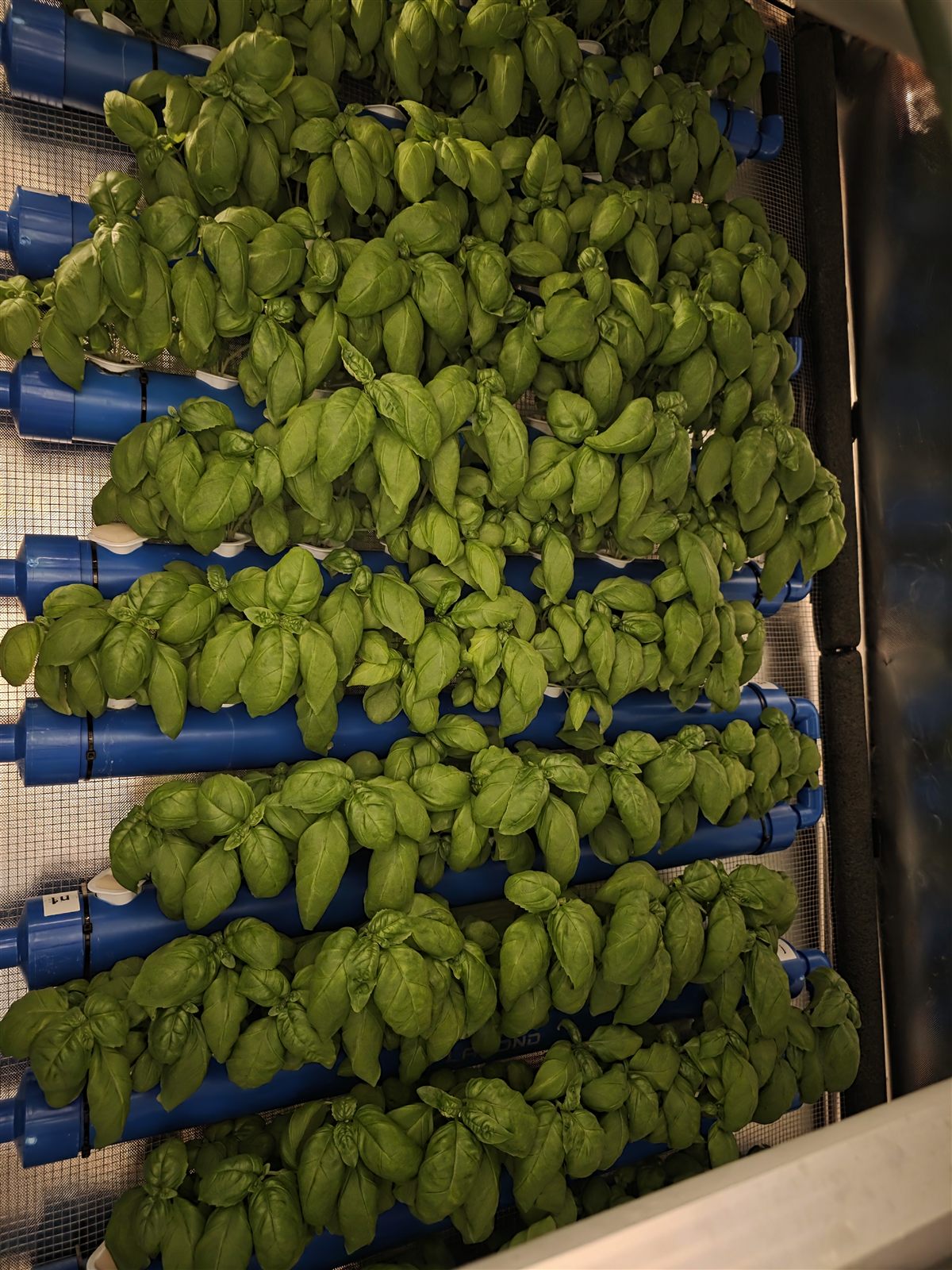
19 grow systems across 12 zones — fog chambers, nutrient-film channels, Dutch buckets, microgreens — with every plant position, reservoir, and recipe in one living database.
Lab-grade probes read pH, nutrient strength, and water temperature; wireless sensors track air, humidity, and vapor-pressure deficit; smart circuits meter every watt the farm draws.
ZAMOS runs its language model on a GPU in the farm building — not in someone's cloud. The farm's data and decisions never leave the property.
Dosing corrections are capped by hard-coded safety rules and executed by a person, never blindly by a pump. If a reading goes critical, ZAMOS cuts equipment power and raises the alarm.
The scheduler keeps heavy tasks out of Colorado's 4–8 PM peak window and meters energy per outlet, so the farm sips power when the neighborhood needs it most.
Each functional area runs its own team of agents on its own schedule — crops, facilities, sales and delivery, procurement, production, and marketing — coordinated by a central orchestrator that also audits the data itself for quality and lineage.
— live message bus · ◉ agent team · every decision traceable to its data
Curated from the actual ZAMOS task calendar — around 127 scheduled jobs run every day. These are the highlights:
Traceability
Because ZAMOS tracks every plant from seed to harvest, every package can carry its own story. A QR code on the label will open that batch's page:
Grown for the neighborhood
ZAM Hydro is a family-operated farm in Castle Rock serving its own community first. Small enough to live where you live; instrumented enough to grow like a lab.
Routes are optimized by ZAMOS across the neighborhood, with cold packs in summer and a photo confirmation when your order lands on the porch.
Order online, pick up at the farm — and see the grow room your herbs came out of, minutes from home.
A sealed grow environment means zero pesticides, no weather losses, and harvests every week of the year — even in January.